This website uses cookies so that we can provide you with the best user experience possible. Cookie information is stored in your browser and performs functions such as recognising you when you return to our website and helping our team to understand which sections of the website you find most interesting and useful.
Search Products

September 4, 2026
The Paper Comeback: Why Schools Are Looking Beyond the Screen
Share on


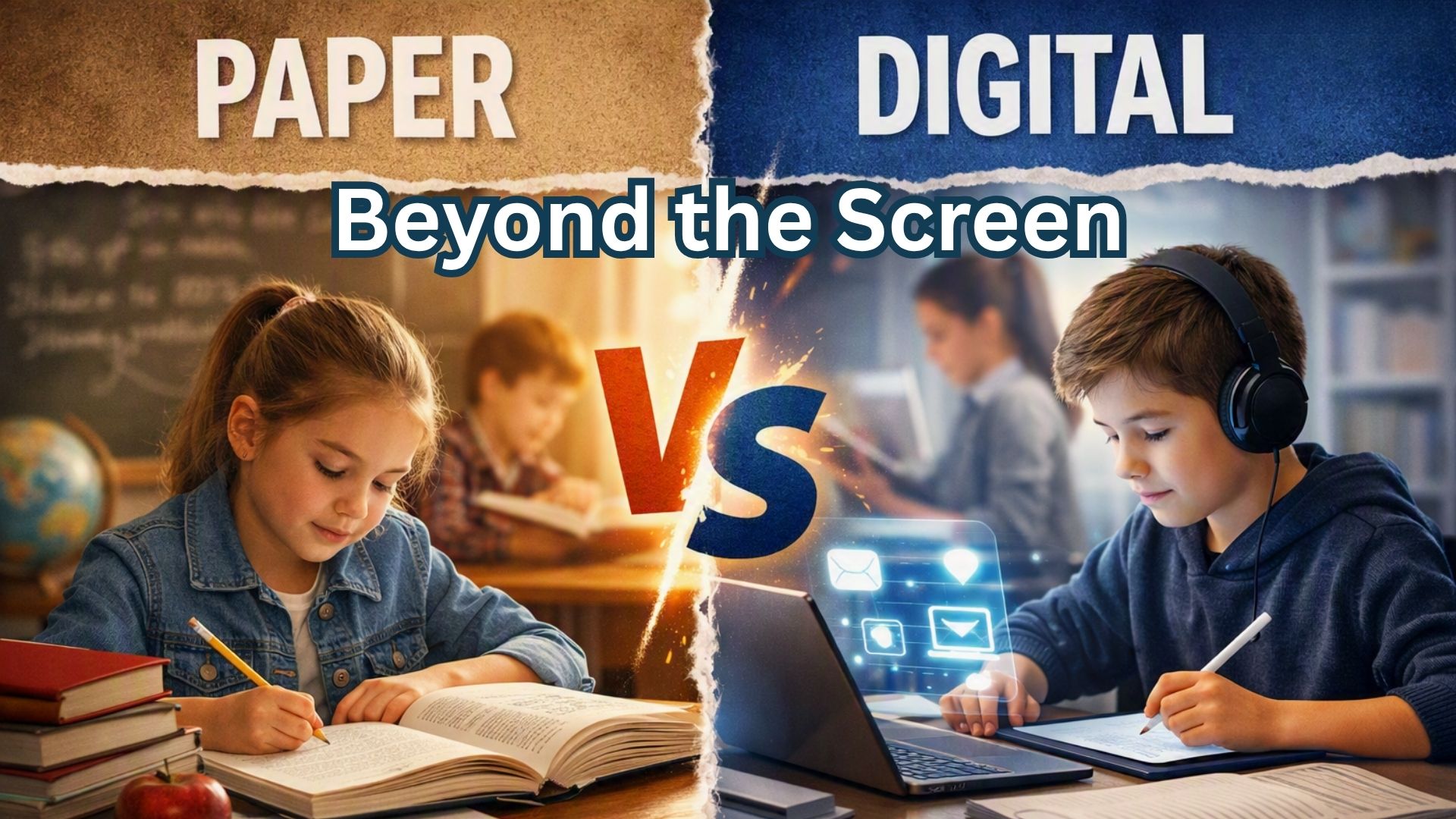 What if the future of education means putting the screen down?
For more than a decade, schools around the world have been moving towards digital learning. Textbooks became apps, worksheets moved online, and laptops and tablets became part of everyday classroom life. But now, something unexpected is happening.
Some education systems that once embraced digital learning are now deliberately bringing books and paper back into the classroom
And it raises an important question:
Have we confused digital with better?
A Shift Is Happening
Sweden has been one of the most visible examples. After years of embracing digital learning, the country is investing heavily in physical textbooks and reading materials, while reducing screen dependence among younger students.
Finland is also rethinking its approach. Some schools that previously relied heavily on laptops have brought printed books and pen-and-paper activities back into classrooms, citing concerns about distraction and concentration.
Denmark has committed significant funding to increase the number of physical teaching books available in schools, while Norway is moving towards guaranteeing access to printed textbooks in primary education.
And the movement isn’t limited to Europe.
Across the United States, more schools and districts are reconsidering screen-heavy learning. Some are reducing access to school-issued devices for younger students and returning to physical textbooks, workbooks and handwritten assignments.
This isn’t about rejecting technology. It’s about using it more intentionally.
Why Does Paper Still Matter?
A screen can deliver information quickly. But learning isn’t simply about receiving information. It’s about reading deeply, thinking critically, remembering, writing and making connections.
A physical book offers something a screen often struggles to provide: fewer distractions. There are no notifications. No pop-ups. No temptation to switch between apps.
A student can underline a sentence, write a note in the margin, flip between pages and physically see their progress through a book.
Handwriting offers another dimension. The act of writing can slow students down and encourage them to process what they are learning rather than simply copying or typing information.
Paper doesn’t make learning better by itself. But in the right situation, it can create an environment that supports better learning.
It’s Not Paper vs. Digital
Perhaps the biggest lesson from this shift is that we don’t need to choose sides.The classroom of the future doesn’t have to be completely digital — or completely paper-based. Students can research online, watch educational videos and use digital tools, then close the laptop and read a physical book or write their ideas on paper.
Technology can make learning more interactive and accessible. Paper can provide focus, familiarity and a space for deeper engagement.
The real opportunity is balance.
Maybe “Old-Fashioned” Isn’t the Right Word
There is something ironic about this movement. For years, using more technology was seen as the definition of progress. Now, some of the world’s most progressive education systems are asking whether certain traditional tools were dismissed too quickly.
- Maybe books aren’t outdated.
- Maybe handwriting isn’t inefficient.
- Maybe paper isn’t something we need to leave behind.
- Maybe we simply need to understand where it still works best.
At OVOL Singapore, we believe the future of print isn’t about competing with digital. It’s about recognising that different mediums serve different purposes. The future may not be paper or digital. It may be paper and digital — used thoughtfully, intentionally and together. Because sometimes, the smartest step forward isn’t adding another screen. It’s knowing when to put one down.
What do you think?
Are we seeing the beginning of a new balance between paper and digital learning? Let’s continue the conversation with educators, printers, publishers, designers and industry partners — because the future of print is something we can shape together.
References
- Government Offices of Sweden. Government investing in more reading time and less screen time. Ministry of Education and Research, 2024.
- OECD. Students, Digital Devices and Success. OECD Education Working Papers / education research on digital device use and student learning.
- The Learning Standard. Why Schools Are Ditching Classroom Screens for Pencil and Paper. April 20, 2026.
Featured Articles

June 4, 2026
Paper Matters: A Strategic Guide to Choosing the Right Paper for Brand and Marketing Materials
Read more