

Categories
Green Paper Paper Supplier Singapore Eco Friendly Paper

Exploring Eco-Friendly Papers: FSC® Certified, Carbon Neutral, and Recycled Paper Explained

With a growing awareness of environmental consciousness more than ever, choosing eco-friendly paper is not only a responsible choice when you need to print but also a significant contribution to preserving our planet for future generations. Let’s embark into the world of eco-friendly paper alternatives and understand their positive impact on the environment.
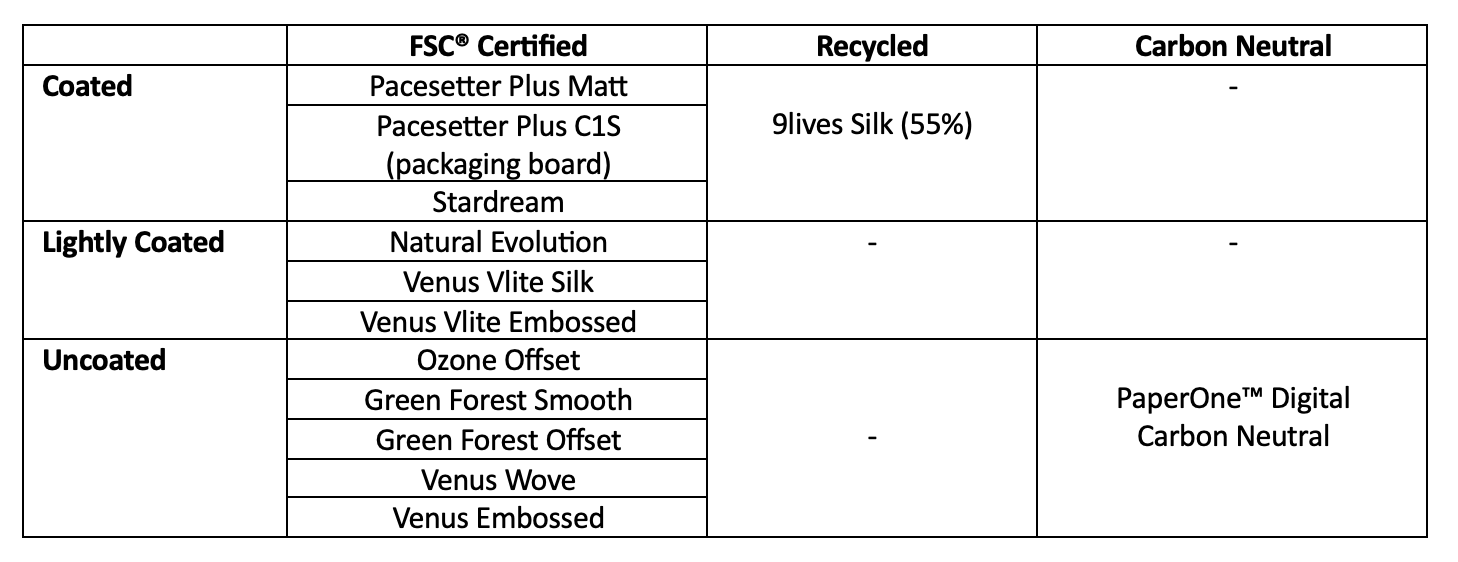


1. FSC® Certified Paper

The Forest Stewardship Council® (FSC®) is an international, non-governmental organisation dedicated to promoting responsible management of the world’s forests1. FSC® certified paper guarantees that the raw materials used in its production are sourced from forests that meet strict environmental and social standards. By choosing FSC® certified paper, you support sustainable forest practices and help preserve biodiversity, protect waterways, and respect the rights of local communities.

2. Carbon Neutral Paper

Carbon neutral paper refers to paper products that are manufactured and produced with the goal of minimising and offsetting the carbon emissions associated with their production and use. This means that the greenhouse gas emissions associated with the production have been measured and reduced as much as possible, and then offset through various means2. Offset strategies often involve investing in projects that reduce or remove an equivalent amount of carbon dioxide (CO2) emissions from the atmosphere, such as reforestation, renewable energy projects, or carbon capture technologies3.

3. Recycled Paper

Recycled paper is made from post-consumer waste paper, which has been collected, processed, and transformed into new paper products. The recycling process involves breaking down the waste paper fibres and reproduce them into usable paper. Using recycled paper helps reduce the demand for virgin wood pulp and conserving natural resources. Recycled paper can be labelled with a percentage that indicates the amount of recycled content it contains, such as 100% recycled or 55% recycled.

In summary, FSC® certified paper ensures responsible forest management, carbon neutral paper aims to have minimise carbon emissions, recycled paper is made from post-consumer waste to reduce the demand for virgin fibres. Each type of paper contributes to environmental sustainability in different ways.

At OVOL Singapore, our commitment is to provide you with the highest quality and most eco-friendly solutions, ensuring a positive impact on the environment while meeting your printing needs. Having covered the three primary types of eco-friendly paper, let’s explore various sustainable printing materials that we offer. Alternatively, chat with us to learn more!

OVOL Singapore is FSC® certified (License Code FSC C015534).

1.https://anz.fsc.org/what-is-fsc

2.https://www.sciencedirect.com/science/article/pii/S2666675821001053

3.https://www.offsetguide.org/understanding-carbon-offsets/what-is-a-carbon-offset/

Categories
Green Paper Eco Friendly Paper

Why Opting for Carbon Neutral Paper Matters

In an era of increasing environmental consciousness, the use of paper has faced growing scrutiny due to its impact on deforestation and greenhouse gas emissions. Many people have become sceptical about the necessity of using paper at all, advocating for a complete transition to digital alternatives. While reducing paper usage is commendable, it is essential to recognise that certain situations still require the use of printed materials. The key lies in adopting responsible practices, such as opting for papers that come from sustainable sources and carbon neutral paper, to mitigate the environmental impact. This article aims to highlight the significance of incorporating carbon neutral paper into our printing practices as another step in sustainable practices.

The Myth of a Paperless Practice

While adopting paperless practices can significantly reduce our ecological footprint, the reality is that some situations still call for printed materials. Educational institutions, government agencies, and businesses often rely on printed documents for legal requirements, physical archives, and ease of reference. Additionally, studies show that many people retain information better when they read printed materials (77% versus 46% to be exact)1, making them valuable for learning purposes.

Embracing Carbon Neutral Paper

Rather than eliminating paper usage entirely, an alternative approach is to consider using carbon neutral paper. Carbon neutral paper refers to paper products that are manufactured and produced with the goal of minimising and offsetting the carbon emissions associated with their production and use. This includes implementing energy-efficient practices, utilising renewable energy sources, optimising transportation logistics, and enforcing carbon offsetting initiatives, such as reforestation, renewable energy projects, or methane capture initiatives2.

Here are some key reasons why choosing carbon neutral paper is a step in the right direction:

  1. Carbon Footprint: By minimising, measuring and offsetting carbon emissions produced during paper production, carbon neutral paper helps reduce the industry’s overall impact on climate change.
  2. Sustainable Practices: By choosing carbon neutral paper and papers that come from sustainably managed sources, consumers actively support environmentally responsible practices in the paper industry. This fosters a culture of sustainability and encourages others to follow suit.
  3. Corporate Social Responsibility: Businesses and organisations that prioritise carbon neutral paper demonstrate their commitment to environmental sustainability, earning trust and support from environmentally conscious consumers.

Instead of avoiding paper altogether, where print is required, we should focus on responsible practices, such as opting for carbon neutral paper when printing is necessary. Embracing carbon neutral paper helps support the reduction in carbon emissions, and encourages sustainable practices in the paper industry. By making conscious choices in our daily lives and supporting environmentally friendly alternatives, we can collectively move towards a more sustainable and eco-conscious future.

In addition to other papers from sustainably managed sources, OVOL Singapore currently carries carbon neutral copier paper that is certified by SCS Global services based on Cradle-to-Grave LCA (Life Cycle Assessment) methodology that analyses the carbon footprint of the entire product lifecycle from raw materials to disposal. Feel free to contact us here for a quick introduction session!

  1. https://www.newsworks.org.uk/research/rametrics/print-vs-digital-advertising/
  2. https://www.offsetguide.org/understanding-carbon-offsets/what-is-a-carbon-offset/
Categories
Food Packaging Board Eco Friendly Paper

From Plastic to Paper: Pioneering A Greener Future with Eco-Friendly Food Packaging

In an era where environmental consciousness is at the forefront of global concerns, the search for sustainable alternatives to everyday products has become more pressing than ever. One critical area that demands attention is food packaging, particularly the shift from plastic to eco-friendly options, namely paper packaging. Here is why paperboard is often considered a better choice for food packaging compared to plastics:

  1. Biodegradability and Recyclability: Paperboard is made from renewable resources, primarily wood pulp, and is biodegradable and recyclable. It breaks down more easily in the environment compared to plastic, which can take hundreds of years to decompose1. Properly recycled paperboard can be used to create new products, reducing waste and promoting a circular economy.
  2. Biobased Coating Options: Paperboard can be coated with biobased food safe materials, like plant-derived waxes or bio-based polymers, to improve its resistance to moisture and grease2. These coatings are more environmentally friendly than traditional plastic coatings2.
  3. Consumer Perception: Many consumers prefer paperboard packaging over plastic due to the perception that it is more eco-friendly and sustainable. Businesses that opt for paperboard packaging can benefit from a positive brand image and increased customer loyalty, as they align with environmentally conscious consumer values.

OVOL Singapore currently offers a range of eco-friendly food packaging boards that can be used to create durable food containers Among these options is the PE Food Board, a polyethylene-coated white board specifically engineered to endure temperatures ranging from -18 to 100 degrees Celsius. This board features exceptional sturdiness while ensuring the consumer safety, being FDA Certified for safe direct contact with food items. Feel free to contact us here to learn more!

  1. https://www.forgerecycling.co.uk/blog/how-long-it-takes-everyday-items-to-decompose
  2. https://www.sciencedirect.com/science/article/pii/S2369969821000840
Categories
Paper Supplier Singapore

Understanding the Importance of Paper Grain Direction in Art and Printing

What is Paper Grain Direction?

Paper grain direction refers to the alignment of the fibres within a sheet of paper during paper production. It determines the direction in which the majority of the fibres align within the paper. There are two main grain directions: long grain and short grain.

On long grain paper, the fibres run parallel to the longer dimension of the paper, whereas on short grain paper, the fibres run parallel to the shorter dimension of the paper1.


Why is it important to know the grain direction?

The grain of the paper determines how the paper reacts to actions like folding, scoring and binding2. Knowing the differences will ensure you use the right kind of paper in your project.


Long Grain Vs Short Grain

When choosing between long grain and short grain paper, consider the following factors:

  1. Project Requirements: Assess the specific needs of your project. Determine if you will be folding, bending, or requiring stability in your design. This will help you identify whether long grain or short grain paper is better suited for your project.
  2. Folding and Flexibility: If your project involves multiple folds, such as in brochures or greeting cards, long grain paper is generally more suitable due to its flexibility and resistance to cracking.
  3. Stability and Rigidity: If your project requires stability, such as in posters or packaging, short grain paper provides better stiffness and resistance to warping, ensuring your design stays intact.
  4. Paper Size and Weight: Consider the size and weight of your project. Larger or heavier designs may benefit from the added stability provided by short grain paper, while smaller or lightweight projects may be more manageable with long grain paper.
  5. Printing Considerations: Consult with your printer or supplier. They can provide guidance based on their equipment and capabilities, helping you make the best choice for your specific printing requirements.

From artcard to woodfree paper, we offer a diverse selection of paper to ensure that we have options that meet your specific project needs. Chat with us to learn more!

  1. https://www.pragati.com/post/grain-direction-why-is-it-important-how-to-pick-the-right-grain-direction
  2. https://jpsprint.co.uk/faq/difference-long-grain-shortcross-grain-web-offset-presses
Categories
Digital Media

Navigating the Digital Shift: Print and Paper in a Post Pandemic World

At the height of the pandemic in 2021, many consumers had shifted from print on paper to the internet and read more on digital devices, across all categories of communications, including; newspapers, magazines, books, catalogues, bills and statements, tax statements and personal health information1.

That trend has reversed, however, with consumer preference for print rising significantly over the past two years. The survey shows that the percentage of European consumers who prefer to read printed books has risen to 65%, up from 53% in 2021. The preference for printed magazines is now 51%, up from 35%. The trend for newspapers and catalogues is similar, with the preference for print up to 31% from 26%, and to 33% from 21%, respectively. The preference for paper bills and statements is also on the rise, up to 38% from 19%1.

Rather than seeing digital channels as competitors, the print industry has embraced digital integration to enhance its offerings. Printers now leverage digital technologies to streamline processes, enhance design capabilities, and provide personalised print solutions. This integration allows for the seamless integration of digital and print marketing, providing customers with a comprehensive and cohesive brand experience.

Advanced printing technologies also enable printers to create highly tailored print materials. Digital printing, for instance, has opened up new possibilities for customisation and innovative print applications. These technologies allow for faster turnaround times, cost-effective short-run printing, and the ability to create unique and eye-catching print materials.

To enhance the effectiveness of print materials, printed pieces often integrate augmented reality to create interactive elements. By incorporating scannable elements like QR codes into print medias, it allows for immersive content, product demonstrations, and direct links to digital platforms, bridging the gap between print and digital media. Cosmopolitan magazine for example, has been including QR codes linked to Amazon storefronts since 20192.

While digital communication continues to thrive, the unique benefits and sensory experience offered by print materials can still make them a valuable and effective part of marketing and communication strategies. Businesses need to assess their target audience, industry trends, and specific objectives to determine the appropriate balance between print and digital in their overall marketing mix.

  1. https://www.twosides.info/UK/european-consumer-preference-for-printed-materials-has-recovered-post-pandemic/
  2. https://www.thedrum.com/news/2021/05/13/bauer-s-bet-making-print-major-part-the-e-commerce-funnel
Categories
Green Paper Eco Friendly Paper

Embracing Carbon Neutral Paper for a Greener World

Carbon neutral paper refers to paper products that are manufactured and produced with the goal of minimising and offsetting the carbon emissions associated with their production and use. The production of paper typically involves various processes that release greenhouse gases, particularly carbon dioxide (CO2), which contribute to climate change1.

To achieve carbon neutrality, paper manufacturers adopt strategies to reduce their carbon footprint. This includes implementing energy-efficient practices, utilising renewable energy sources, optimising transportation logistics, and improving overall production efficiency. By minimising carbon emissions during the manufacturing process, they aim to reduce the environmental impact of paper production.

In addition to emission reduction efforts, carbon neutral paper may involve the concept of carbon offsetting. Carbon offsetting refers to investing in projects or initiatives that help reduce or remove greenhouse gas emissions elsewhere, often in different locations or industries. These projects could include reforestation, renewable energy projects, or methane capture initiatives2. The goal is to balance or offset the carbon emissions generated during paper production by supporting projects that have a positive environmental impact.

Certification programs and standards exist to verify and validate the carbon neutrality of paper products. These programs assess the emissions associated with the entire lifecycle of the paper, including raw material extraction, manufacturing processes, transportation, and disposal. Carbon neutral certifications provide assurance to consumers that the paper they are purchasing has been produced with a reduced carbon footprint and any remaining emissions have been offset through credible projects.

To further show our commitment, OVOL Singapore currently carries carbon neutral copier paper that is certified by SCS Global services based on Cradle-to-Grave LCA (Life Cycle Assessment) methodology that analyses the carbon footprint of the entire product lifecycle from raw materials to disposal. Feel free to contact us here for a quick introduction session!

  1. https://www.sciencedirect.com/science/article/pii/S2666675821001053
  2. https://www.offsetguide.org/understanding-carbon-offsets/what-is-a-carbon-offset/
Categories
Graphic Paper

Does Eco-Friendly Paper Come With A Heftier Price Tag?

In truth, the price difference between normal paper and FSC® (Forest Stewardship Council®) certified paper varies depending on several factors, such as the type and quality of the paper, the supplier, and the region.

Generally speaking, FSC® certified paper can be slightly more expensive than non-certified paper, as the production process requires additional steps to ensure that the wood used comes from responsibly managed forests.

The additional steps in the production process for FSC® certified paper includes:

  1. Forest Management: FSC® certification requires that forests are managed in a responsible and sustainable way1, which might involve increased costs for the forest owners and operators.
  2. Chain of Custody: FSC® certification requires that the chain of custody is maintained throughout the entire supply chain from forest to end user2. This requires additional tracking and documentation, which can add to the cost of production.
  3. Auditing: To make sure that the requirements for chain of custody and forest management are being met, FSC® certification needs routine auditing. These auditing fees may increase the price of the final product3.It’s important to note that while the cost of FSC® certified paper may shift depending on market factors, the environmental and social benefits of using FSC® certified paper remain the same. By choosing FSC® certified paper, individuals and organisations can support responsible forest management practices and contribute to the conservation of natural resources.

In February 2021, The Institute of Policy Studies revealed that Singaporeans have become more environmentally conscious. Three-fifths of those surveyed felt that protecting the environment should be prioritised even if it results in slower economic growth and some job losses. This was a jump from 43% in 20124.

As the leading paper and material supplier in Singapore, OVOL Singapore holds the accolade of being the first paper supplier in Singapore to receive FSC® certification and is dedicated to ensuring that its clients extend their sustainable practices to their printed materials.

OVOL currently procures a comprehensive line of FSC® certified papers across various grades and finishes including packaging materials and fancy papers. One of the best seller from our fancy ranges is Venus. With unique shade and delicate coating, it is suitable for use in all printing and visual communication needs – be it for catalogues, brochures, calendars, greeting cards, coffee table books, inserts and many more.

Click here to get in touch with our team today!

OVOL Singapore is FSC® certified (License Code: FSC C015534).

  1. https://fsc.org/en/fsc-solutions
  2. https://fsc.org/en/chain-of-custody-certification
  3. https://connect.fsc.org/innovation-sustainability/digital-audit-reporting#:~:text=FSC%20is%20an%20international%20organization,and%20economically%20viable%20forest%20management
  1. https://www.statista.com/statistics/1089078/demand-paper-globally-until-2030/
Categories
Graphic Paper

Do People Still Read Printed Magazines?

Contrary to popular belief, the answer is yes. Many people still do read printed magazines, despite the increasing trend of digital platforms. While the growth of the internet and smartphones might have led to a decline in the print industry, there are still people who prefer the haptic experience of flipping through a physical magazine.

Credit to TwoSides1, here are several reasons why some people still prefer to read magazines in their printed form even with the abundance of digital content available.

1. We Find Magazines Trustworthy

Trust appears to be an important factor, particularly with regard to topical news magazines. In a world where ‘fake news’ appears to be ever more prevalent, magazines are considered a trusted source of information. The Ofcom News Consumption Survey2 found that when rated on measures such as quality, accuracy, trustworthiness and impartiality, magazines continue to perform better than other platforms.

2. Magazines Give Us Time To Focus Without Distraction

When we read a magazine, 58% of us will be fully engaged with what we are reading or looking at in the magazine3. That compares with just 35% of us who will be fully focused when reading online3, when we’re much more likely to be multitasking or being lured into a rabbit warren of links that take us away from what we originally had set out to read.

A printed magazine, on the other hand, has been carefully and skilfully edited and designed, distilling the most interesting and useful information for us and guiding us through it in a focused and linear fashion. Journalist Ferris Jabr describes magazines as offering a generous canvas for words and images, which means more opportunities for visual landmarks that help people establish a sense of progress in a text and remember where in the publication they read something4. Of course, we can bookmark the pages of a digital magazine, but how many of us actually will go back and look at that bookmark – we’re usually too busy being side-tracked by a whole plethora of links to yet more information.

3. Magazines Engage Our Senses

The feel and weight of the magazine in your hands, the sound of the crisp crackle of the paper as the page turns, the smell of ink on paper, the visual pleasure of the design with text and photography juxtaposed – magazines offer a multi-dimensional experience, which according to an article in The Psychologist4, can improve memory and depth of understanding.

4. Magazines Create A Learning Mindset

Psychological studies also suggest that readers approach the printed word with more of a learning mindset than they might on a screen version. Ferris Jabr believes that the features of a magazine make it easier to form a coherent mental map of the text4. In contrast, most screens, e-readers, smartphones and tablets interfere with intuitive navigation of a text and inhibit people from mapping the journey in their minds.

5. Printed Magazines Can Serve Many Functions

As a physical object, a magazine is something we can engage with on many levels. Dr Matt Hayler, a senior lecturer in contemporary literature and digital cultures at the University of Birmingham, says, a magazine is something you can cut things out from, a magazine is something you’re happy to leave on a train or doctor’s office, you’ll use it as a coaster or fly swatter… there’s something very functional about a magazine4.

6. Printed Magazines Encourage Us To Spend Time Away From Our Screens

When we choose to pick up and read a printed magazine, we are giving ourselves permission to take some time away from our digital screens, which increasingly seem to dominate our lives inside and outside of work. We might put the kettle on, make a cup of tea, and sit down in a favourite chair for half an hour, quietly reading an article or flicking through pages, possibly forgetting, momentarily, that the distractions of the digital world even exist.

As Singapore’s largest paper supplier, OVOL Singapore offers a wide range of paper materials that are guaranteed to capture your magazines readers’ attention . We also carry broad variety of eco-friendly substances that are suitable for offset printing and digital printing. Feel free to contact us here to assist you with finding the most suitable material for your magazine projects!

  1. https://www.twosides.info/UK/when-was-the-last-time-you-read-a-printed-magazine/
  2. https://www.ofcom.org.uk/__data/assets/pdf_file/0013/201316/news-consumption-2020-report.pdf
  3. https://www.marketingweek.com/magazine-industry-calls-on-brands-to-pay-more-attention-to-attention/
  4. https://www.bps.org.uk/psychologist/why-magazines-matter
Categories
Eco Friendly Paper

Vote For A Greener Future: Sustainable Packaging

Many of you may have heard of the term sustainable packaging. It refers to packaging materials that minimise negative impacts on the environment while still effectively protecting your products. It aims to reduce waste, conserve resources, and minimise carbon footprint by using materials that are biodegradable, recyclable and sourced from sustainably managed forests.

According to Two Sides, over the last five years, the forces pushing for sustainability have strengthened around the world. FMCG companies and retailers have made bold commitments responding to public concerns about single-use packaging waste. More recently, the Covid-19 pandemic has further reshaped the sustainability sentiment.

Concern for the environment is not normally led by legislators, more generally they are responding to interest from the general public and other interest groups. Strong pressure is now being applied to brand owners by consumers. Ocean pollution of non-biodegradable materials has become widely understood following increasing media attention.1 Consumers are demanding products that use responsibly sourced, efficiently produced and fully recyclable packaging.

A 2020 survey found that consumers are adapting their purchasing behaviours to reflect shifting environmental preferences. 70% of consumers are actively taking steps to reduce their use of plastic packaging. Nearly half (48%) of consumers would even avoid retailers that are not actively trying to reduce their use of non-recyclable packaging.2

In another recent study, 75% of European consumers say the environmental impact of a product’s packaging affects their decision-making process. 77% said they would pay more for a product if it came in more sustainable packaging, with one in five willing to pay 10% or more extra.3

Furthermore, paper packaging is preferred by consumers for many environmental and practical attributes4, including:

  • Home compostable, 72%
  • Better for the environment, 55%
  • Easier to recycle, 51%
  • Lighter weight, 62%
  • Easier to open, 41%
  • Easier to store, 41%

That being said, packaging is often the first physical interaction between a brand and its customers. As consumer demand for sustainable packaging grows, businesses have a unique opportunity to enhance perceptions of their brands through their packaging choices. Using sustainable packaging often helps brands positively connect with consumers.

OVOL Singapore currently offers a range of sustainable packaging materials, one of them being Pacesetter Plus C1S, an FSC® Certified Packaging Board. Featuring high bulk, excellent printability and good converting properties, it is designed to suit most of your packaging needs. Feel free to reach out to our team to find out more! 

OVOL Singapore is FSC® certified (License Code: FSC C015534)

  1. https://www.smithers.com/resources/2019/dec/packaging-sustainability-trends-guide
  2. https://www.twosides.info/documents/research/2020/packaging/European-Packaging-Preferences-2020_EN.pdf
  3. https://www.procarton.com/wp-content/uploads/2018/10/European-Consumer-Packaging-Perceptions-study-October-2018.pdf
  4. https://www.twosides.info/documents/research/2020/packaging/European-Packaging-Preferences-2020_EN.pdf